

Why a no-code platform is the best thing you can give an AI agent


In May 2025 we introduced MARCO AI Copilot, an assistant built into MARCO Track & Trace that let users configure a supply chain by describing it in natural language. It was a useful first step. Since then, AI has moved faster than any of us expected.
The biggest shift is that AI no longer just answers questions. AI agents can now operate software. They read what is already there, plan a change, carry it out and check the result. And many teams already use one in their daily work.
So we changed direction. Instead of building our own AI into MARCO, we are opening MARCO to the AI agents our customers already use. We call it MARCO for AI agents, and it is the next stage of our AI strategy.
What we changed
Our team now configures and runs MARCO Track & Trace through AI agents. MARCO for AI agents gives the AI two things: the tools to act on MARCO, and the know-how to use them well, from choosing the right building blocks to checking its own work. It will work with the AI assistants many teams already use, including Claude, OpenAI's Codex and GitHub Copilot.
The difference from the 2025 Copilot is scope. The Copilot helped draft a supply chain structure. With MARCO for AI agents, an AI assistant can do almost everything a MARCO administrator or operator can do. It can:
- design supply chains, asset templates and their properties
- build workflows with every MARCO step type, from transfers and property changes to conditional logic, inventory steps and system integrations
- set up the parts of a workflow suppliers fill in themselves, showing them only the fields they need
- add steps that read a supplier certificate or invoice and pull out the data automatically
- set up facilities, products, units and inventories
- start workflows, execute and correct steps, trace the full history of any asset, check inventory balances and open and close balance periods
We recently put this to work on a demanding case. A customer needed our Mass Balance module configured for more than 20 SKUs, made from more than 10 different feedstocks, all certified under ISCC PLUS. Each feedstock brings its own certificates and sustainability data, and each SKU needs its own balance and claims. An implementation like this used to take a couple of weeks of configuration alone. With an AI agent working through MARCO, we deployed it in a matter of hours, ready for user testing and validation.
The same approach applies to EUDR, the largest part of our business today. MARCO for AI agents includes a ready-made pattern for the whole due-diligence flow, from supplier data and evidence through to submission. Instead of designing that process from scratch, the agent adapts the pattern to each company's products and suppliers.
Configuration, not code
Most enterprise software was never designed to be operated by an AI. Changing it means changing code, and code written by an AI still needs developers to review, test and deploy it.
MARCO is different because of a decision we made years ago. Everything in the platform is configuration, not custom code, and every feature is available through our API. When a compliance manager wants a new supplier declaration field or an extra verification step, nobody writes software. Someone changes the configuration.
That makes MARCO a natural partner for Gen AI. The agent does not invent a system. It works inside a tested, audited platform with clear building blocks, the same way an experienced MARCO consultant would. Gen AI brings the ability to turn a messy human explanation into a structured design. MARCO brings the structure, the data model and the audit trail.
From explanation to working workflow
Here is what this look's like in practice. A sustainability lead at a biofuels producer explains to her AI assistant, in her own words, how feedstock arrives, which certificates suppliers must provide, how batches get blended and how mass balance credits should be tracked.
In our projects, the agent typically asks the questions a skilled consultant would ask. Which sites are involved? Who signs off on the sustainability declaration? What happens if a certificate is missing? It then reads the organisation's existing MARCO setup, so it reuses facilities and products that already exist instead of duplicating them.
Next, it proposes the design in plain language: the assets, the properties on each one and the steps in each workflow. Suppliers get a simple form with only the fields they need, and a step reads each uploaded ISCC certificate and pulls out the data automatically. Once the team is happy, the agent builds the workflows as drafts, checks that every element was created as intended and summarises what it did. Nothing goes live until the team switches it on.
The real value shows up a few weeks later. A regulation is updated, an auditor asks for an extra data point or a new supplier joins with a different process. The team describes the change, reviews the proposal and confirms. An adjustment that used to mean a change request and a wait now takes a conversation.

Guardrails come built in
Speed only matters if the result can be trusted. The agent can only do what you are allowed to do. People will sign in with their own MARCO account, and service accounts remain an option for automation. New workflows start as drafts and only go live when someone switches them on. The agent checks its own work after each change. Underneath, MARCO keeps doing what it has always done: recording every step in a tamper-proof, auditable trail, on a platform that holds SOC 2 Type II certification.
Build or buy, now that everyone has AI
With GenAI writing code faster than ever, a question comes up more often in our conversations. Could a company simply build its own traceability tool with AI?
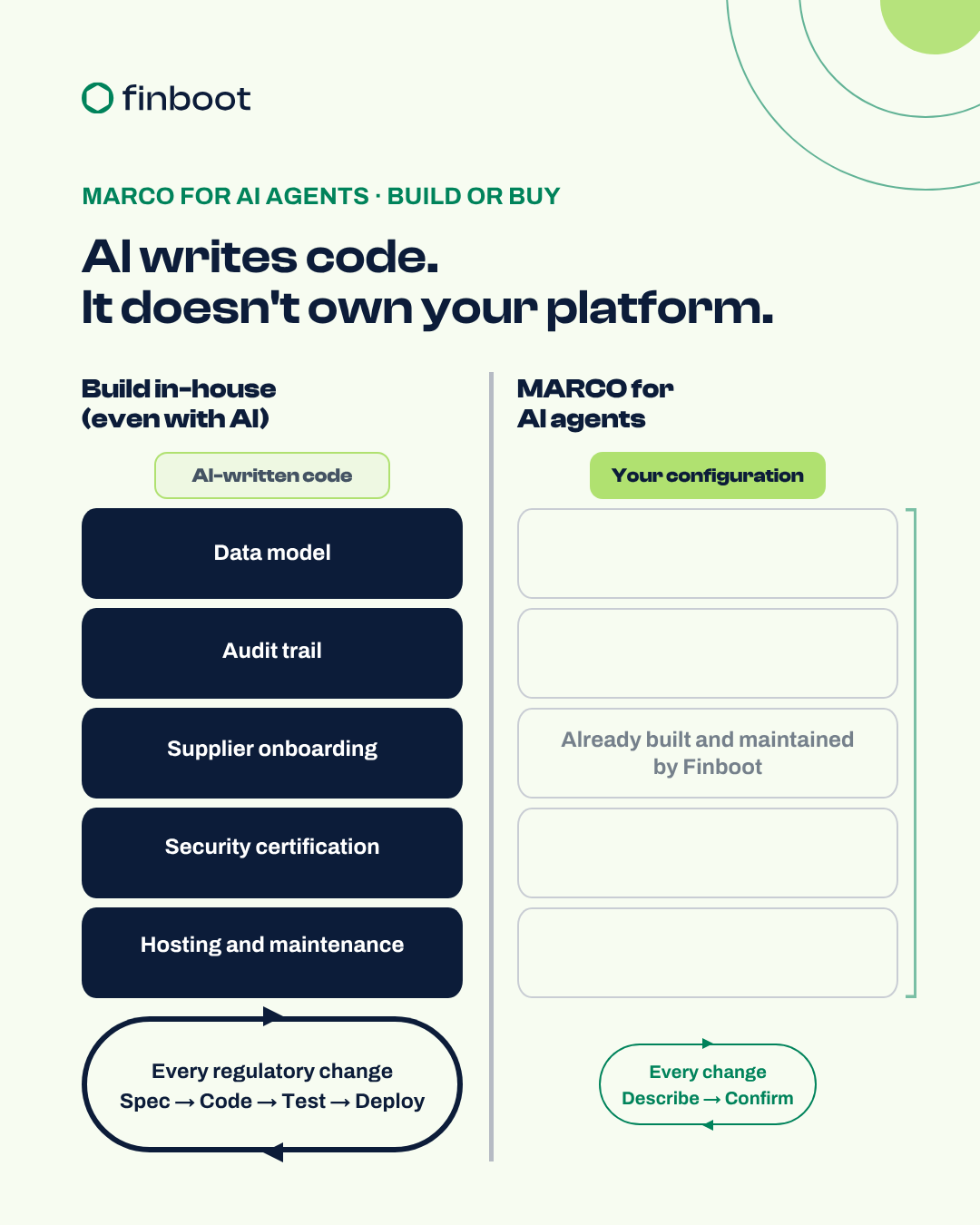
AI makes code cheaper to write. It does not make the rest of a production system cheaper to own. A compliance-grade traceability platform needs a data model that handles segregation, mass balance and book and claim. It needs supplier onboarding, an immutable audit trail, security certification, hosting, monitoring and years of maintenance. AI can help write all of that, but the organisation still has to design it, test it, secure it and carry it.
The bigger cost is iteration. Compliance requirements change constantly. In an internal build, each change goes back through the development cycle, AI-assisted or not: specification, coding , testing, deployment. Someone also has to keep the AI's knowledge of the system current every time the system changes. With MARCO, the platform already exists and the know-how ships with the tool, so the AI keeps up as MARCO evolves. Each iteration becomes a conversation followed by a confirmation.
That is the real difference in entry cost. Companies get the flexibility of a tailored solution and put the AI they already use to work, without becoming a software company.
Looking ahead
We built MARCO for AI agents for our own team first, and it has already changed how we deliver projects. The next step is to put it in our customers' hands. It is coming soon, so their teams can design, adjust and run their supply chains in plain language, through the AI assistant they already use.
Want a sneak peek before then? Book a session with our team and we will show you MARCO for AI agents in action.


