

AI Traceability Implementation Advisor for Industrial Supply Chains
Turn traceability complexity into a clear implementation roadmap.
An AI-powered advisor built to help energy, chemicals, fuels, and circular-materials teams understand how to design, implement, and scale digital traceability solutions. Built on Finboot’s industry expertise, real implementation experience, and proven traceability use cases across circular and renewable value chains.

.png)





This GPT is focused on the real traceability needs of clean energy, renewable fuels, chemicals, and circular products — not generic supply chain advice.
It understands key concepts such as: Mass balance Chain of custody, Proof of Sustainability (PoS), Supplier data collection, GHG tracking, Certification workflows, Digital Product Passports (DPP), ERP and API integrations, Audit-ready reporting.
Finboot’s implementation approach is based on modular workflows, auditable records, system integrations, and configurable traceability ecosystems for complex value chains.
The advisor reflects practical knowledge from real traceability initiatives, including renewable fuels, HVO, green hydrogen, chemicals, blockchain-based audit trails, and supplier-data workflows.
The toolkit references traceability use cases across companies such as MOEVE Chemicals, Repsol, SABIC, Evonik, Gestamp, and Acelen Renewables, showing how leading companies are moving from paper-based documentation toward digital, auditable traceability systems.
The AI Traceability Implementation Advisor for Industrial Supply Chains does not only explain traceability. It helps users shape an implementation plan.
What can this advisor help you do?
- Design a digital traceability architecture
- Define mass balance and chain-of-custody models
- Prepare for EUDR, RED III, ISCC, and DPP
- Identify supplier data and GHG tracking requirements
- Build a traceability business case
- Plan implementation roadmap and pilot
The implementation model follows a practical journey: discovery, workflow design, sandbox configuration, testing, ERP/API integration, onboarding, and continuous improvement .
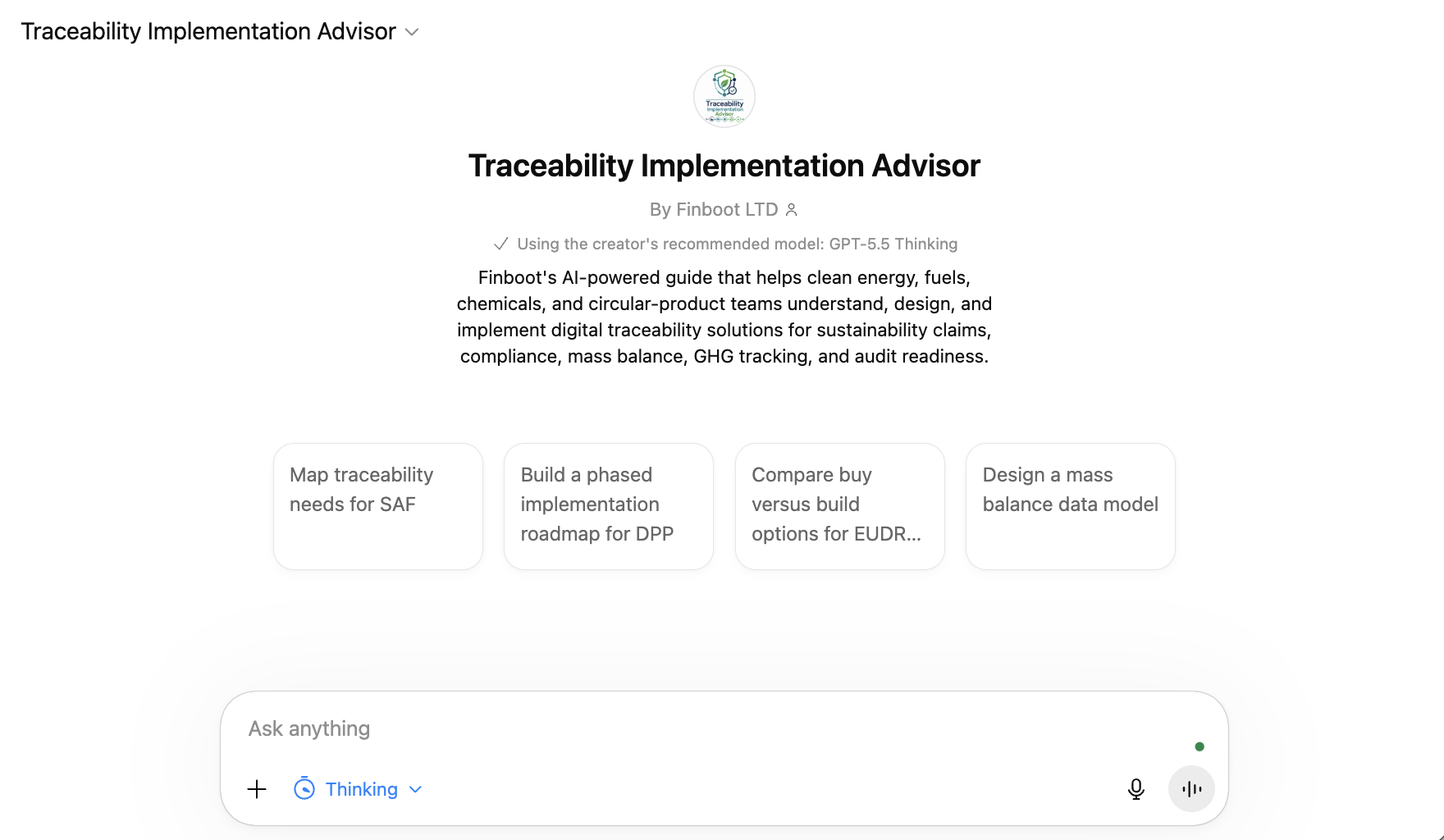
Ask your first question and get practical guidance in minutes.
Popular starting questions:

Use it to understand how traceability supports ESG claims, audit readiness, GHG reporting, and anti-greenwashing.

Use it to define pilots, evaluate technologies, compare buy-vs-build options, and map system integrations.

Use it to identify data gaps, custody-transfer points, supplier requirements, and process inefficiencies.

Use it to explore how traceability supports ISCC, RED III, REDcert, EUDR, Digital Product Passports, and audit workflows.
Use it to understand how verified sustainability claims can improve market access, customer trust, and product differentiation.
Use it to quickly understand where traceability creates business value, reduces risk, and supports strategic transformation.
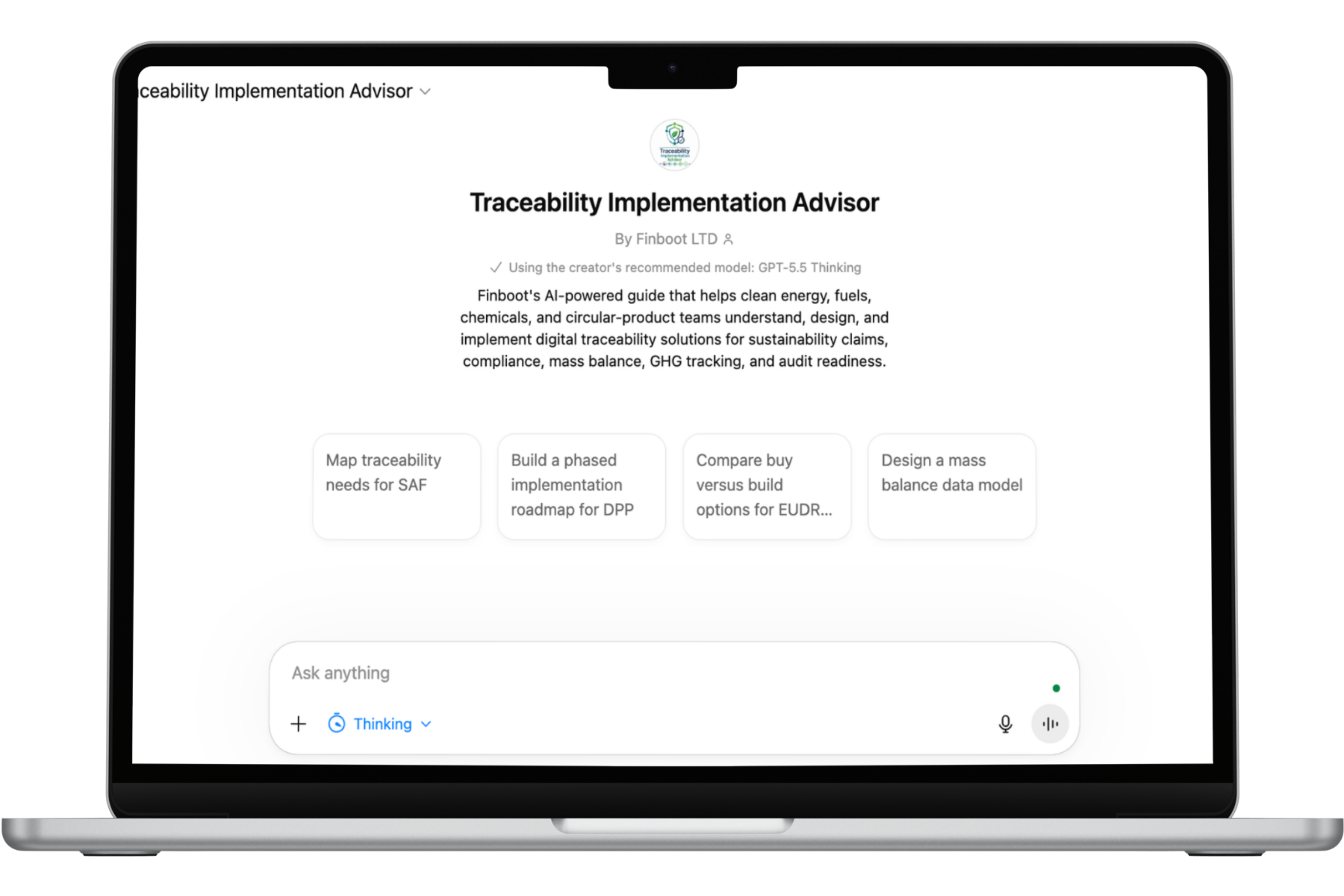
Use the AI Traceability Implementation Advisor for Industrial Supply Chains by Finboot to explore your use case, then request a free audit to understand how your organization can move from manual processes and fragmented data to a scalable, audit-ready traceability ecosystem.
Want to understand where your organization stands?
Request a free initial audit and receive a high-level view of your traceability maturity, key gaps, and possible next steps.
.svg)
