MARCO for GHG & PCF
Carbon numbers per batch and per part, from primary data.
Buyers and regulators no longer accept industry averages. MARCO collects primary data from suppliers, ERP and assets, calculates the footprint of every batch and part, and passes it down the chain with the material.

- CBAM
- In its definitive phase since January 2026, with verified embedded emissions per shipment
- Cradle to gate
- Footprint and recycled content for every batch and every part
- Scope 1, 2 and 3
- Collected, calculated and auditable across the supply chain
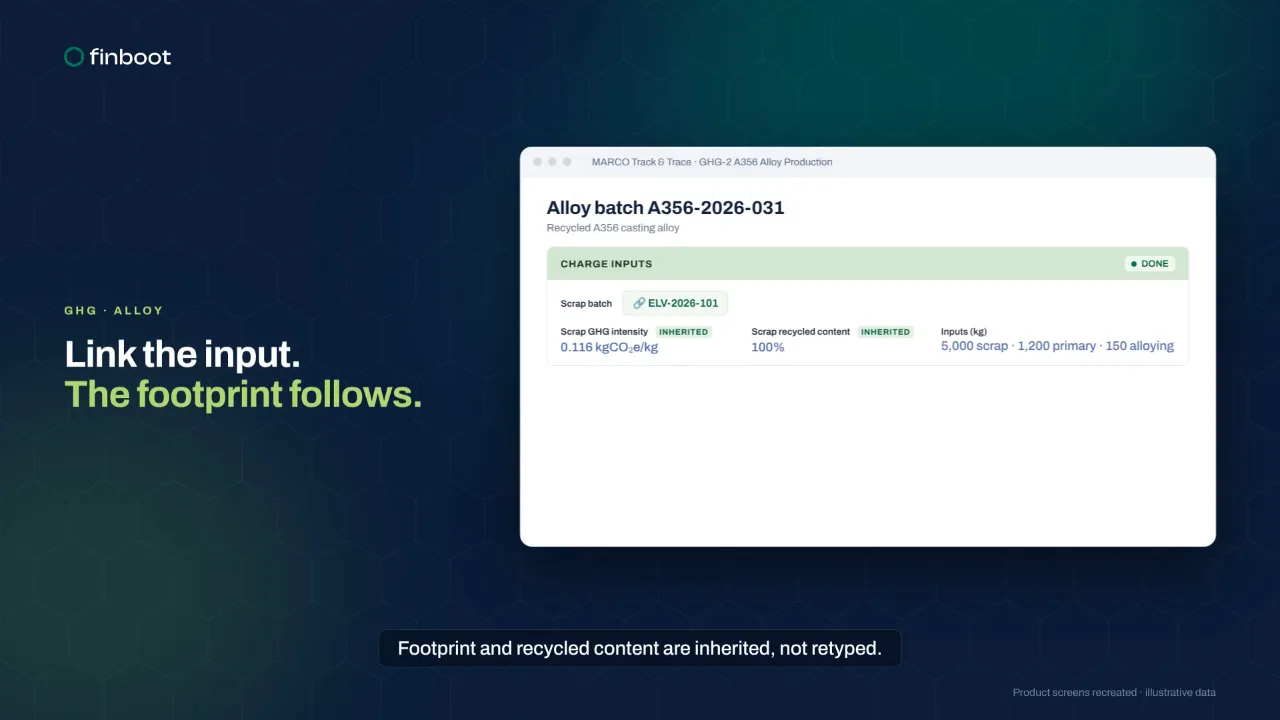
Link the input batch, and its carbon comes with it: from scrap to finished part.
Three numbers you’re asked to prove
Most companies already have the corporate number. The product number and the regulatory number are where the data is missing, and that is the gap MARCO fills.
Corporate footprint
Scope 1, 2 and 3 for annual reporting, investors and CSRD disclosures. Scope 3 is where the data runs out.
Product footprint
The footprint of one batch or one part, cradle to gate. Vehicle makers now ask suppliers for it per part, with recycled content.
Regulatory numbers
CBAM embedded emissions, RED III carbon intensity and methane data under OGMP 2.0: numbers a regulator checks.
How it works in MARCO
An example from an aluminium chain: from scrapped vehicles to a cast sub-frame. Each company sees and enters only its own data.
- 1
Recovery
The dismantler records a batch of vehicles and the aluminium recovered. Collection, dismantling and transport emissions are calculated, and the scrap starts at 100% recycled content.
- 2
Alloy production
The alloy producer links the scrap received and adds primary aluminium and furnace energy. The upstream footprint arrives with the material, not by email.
- 3
Casting
The foundry links the alloy batch and records the parts produced. Every part gets its footprint, its recycled content and the saving against primary aluminium.
- 4
Factors and stock
Emission factors are visible, editable defaults you can swap for verified values. Physical stock is tracked alongside, so quantities and footprints can’t drift apart.
Every framework, one data set
What clients are asked to deliver, and how MARCO does it.
Track emissions
Automated collection, calculation and audit trail for Scope 1, 2 and 3 across the supply chain.
Product footprint
Cradle-to-gate footprint and recycled content per batch and per part, inherited along the chain and embedded in product passports.
CBAM
Manage and trace CBAM certificates with verified emissions data for EU import declarations.
Renewable fuels
Well-to-wheel emissions for RED III, RFS, LCFS, RTFO and other schemes. A lower verified number is a higher price.
Methane
Abatement measures and emission factors tracked at asset level for OGMP 2.0 and the EU Methane Regulation.
Carbon credits
Issuance, transfer and retirement of credits, with insetting and offsetting linked to verified reductions.
Carbon capture
A digital trace of captured CO₂ volumes, transport, use and storage, ready for audit.
Who it’s for
Carbon rules reach producers at home and exporters at the border. Each sector hears a different acronym; the data problem underneath is the same.
Renewable fuels
Carbon intensity for ethanol, biodiesel, SAF and HVO under RED III, RFS, LCFS and RTFO.
Steel, aluminium and cement
Verified embedded emissions per shipment for EU importers under CBAM, plus fertilisers.
Oil and gas
Methane abatement and asset-level emission factors for OGMP 2.0 and imported oil and gas.
Automotive suppliers
Footprint and recycled content per part, across recyclers, alloy producers and foundries.
“A highly professional team focused on proposing the best solution for each client, meeting objectives on time and in the right manner. Flexibility of the team and ability to integrate with other tools.”
Repsol and Moeve trace emissions on MARCO in energy, Gestamp in automotive and Sendero for methane.
See it on your productsQuestions we hear
We already report emissions once a year with a consultancy.
An annual corporate total doesn’t answer a customer asking for the footprint of this batch, or an importer filling in a CBAM declaration. MARCO gives you per-batch numbers, continuously.
Our data is estimates anyway.
MARCO captures primary data at source, from suppliers, ERP and assets, and shows where estimates remain so you can replace them one by one.
Connected to the rest of MARCO
The same batches carry origin, certified content and footprint, so one data set answers every request.