.svg)

EUDR 2026 After the Amendments: Operational Implications for Operators, Downstream Actors and Traceability Systems

When Regulation (EU) 2025/2650 was adopted in December 2025, many organisations interpreted it as a regulatory softening of the EU Deforestation Regulation (EUDR). Legally, it introduces simplifications. Operationally, however, it introduces precision.
Over the past year, while supporting industrial leaders (including multinational chemical manufacturers navigating complex, multi-tier supply chains), I have seen how difficult it is to translate EUDR from legal language into executable process. The 2025 amendment does not dilute responsibility. It clarifies roles, redefines downstream obligations and places traceability systems at the centre of compliance.
For companies preparing for EUDR 2026, the question is no longer “Who submits a due diligence statement?” The question is whether their internal systems can structurally distinguish operators from downstream actors, manage declaration identifiers and reference numbers correctly, and withstand quantified enforcement thresholds.
Amended EUDR reshapes the operational logic of the Regulation. Understanding that shift now will determine whether implementation in 2026 is controlled — or reactive.
1. The Timeline Has Shifted, But the Pressure Has Not
Under Article 38 as amended :
- The main obligations now apply from 30 December 2026
- For operators that are natural persons or micro/small undertakings established as such by 31 December 2024, obligations apply from 30 June 2027
This 12-month postponement was introduced to allow businesses and IT systems to prepare.
But what I see in practice is different:
The regulatory bar hasn’t been lowered, It has simply given companies one more year to build infrastructure properly.
And infrastructure is the real issue.

2. The Most Important Structural Change: A New Supply Chain Category
The final text agreed by both Parliament and the Council on December 2025, formally introduces a new category:
“Downstream operator”
This matters enormously.
Previously, many companies assumed that every transformation restarted due diligence. That assumption is now clearly incorrect.
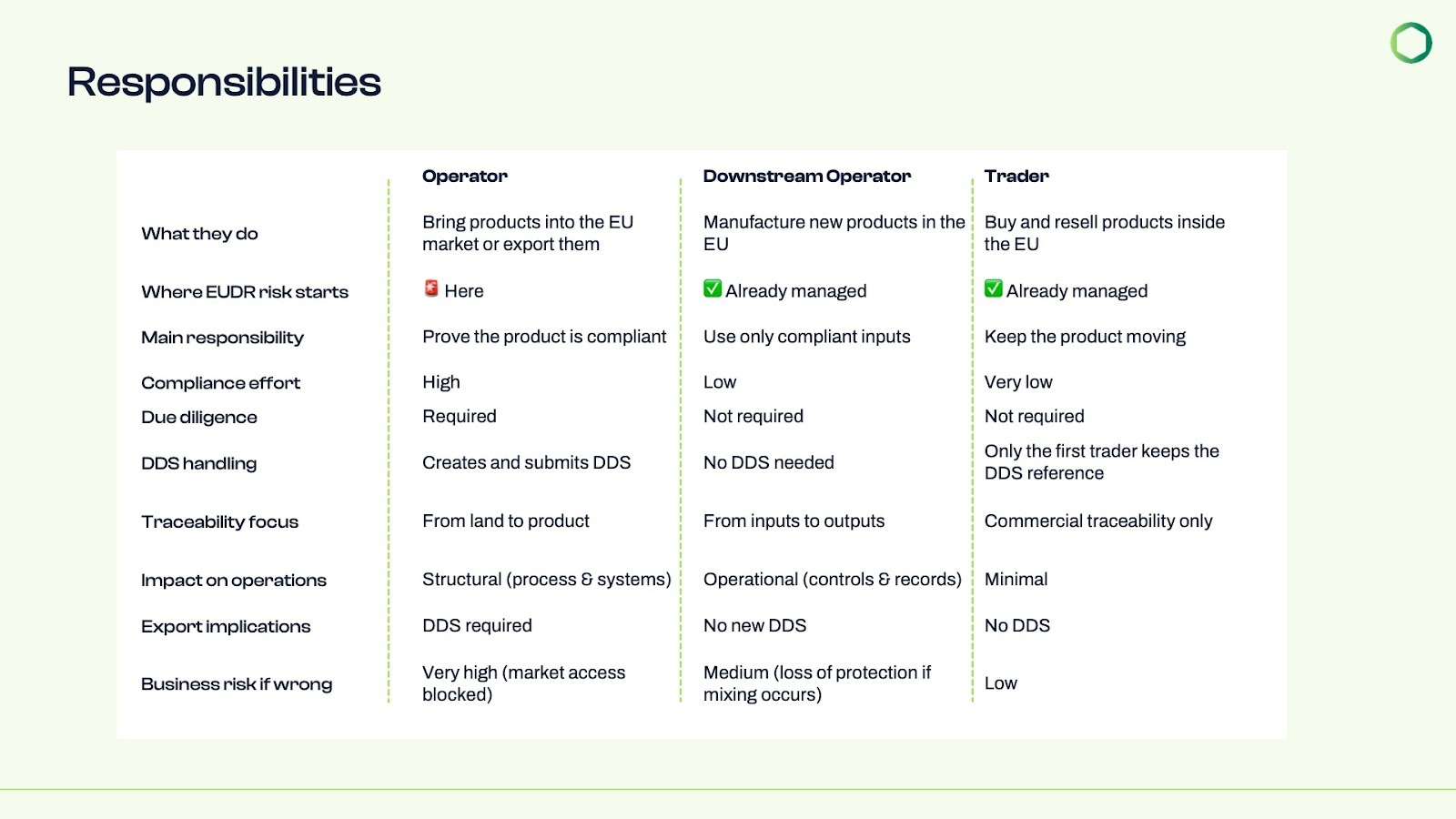
Below is a simplified representation of the updated structure under the amended Regulation:
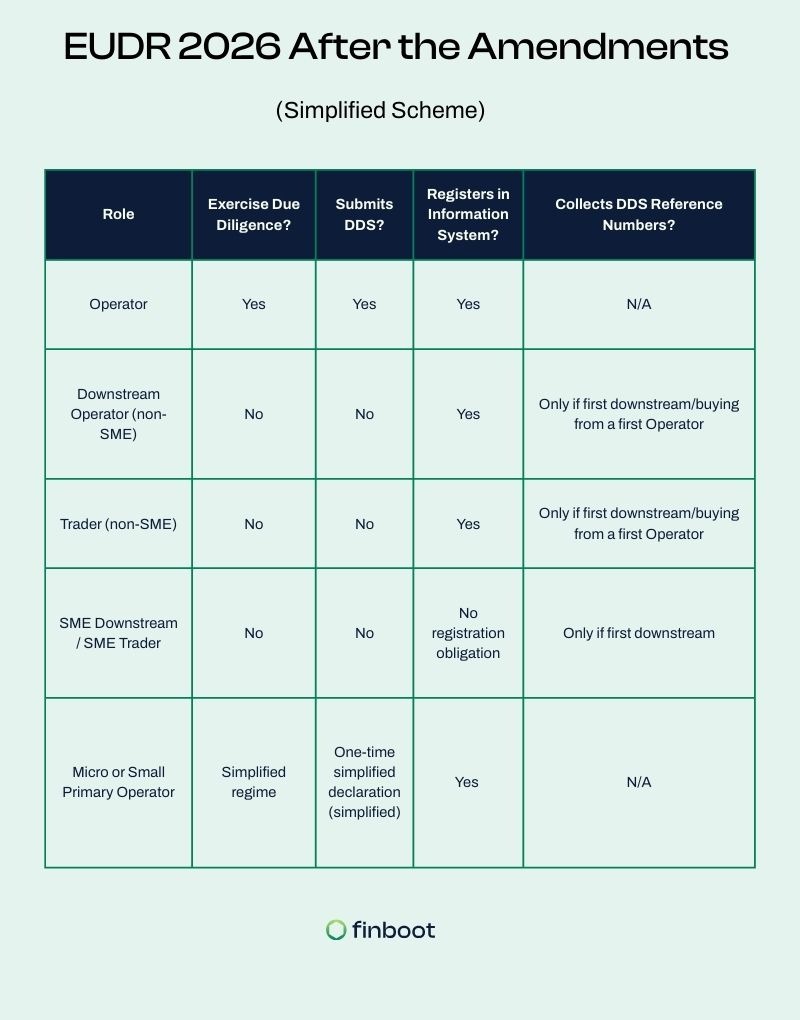
The legal basis for this restructuring appears in the amended Articles 2, 4 and 5 .
What changed in substance?
Downstream operators and traders:
- No longer submit due diligence statements
- No longer “ascertain” due diligence in the previous way
- Must collect and retain specific information
- Must ensure traceability continuity
- The obligation to collect DDS reference numbers applies only to the first downstream operator or trader
This is not cosmetic.
It fundamentally reduces duplication in the Information System.
But it does not remove traceability obligations.
3. Reference Numbers: The Most Misunderstood Obligation
In nearly every EUDR workshop I lead, reference numbers become the moment of confusion.
To clarify this visually, below is the simplified logic we use internally to explain it to clients:
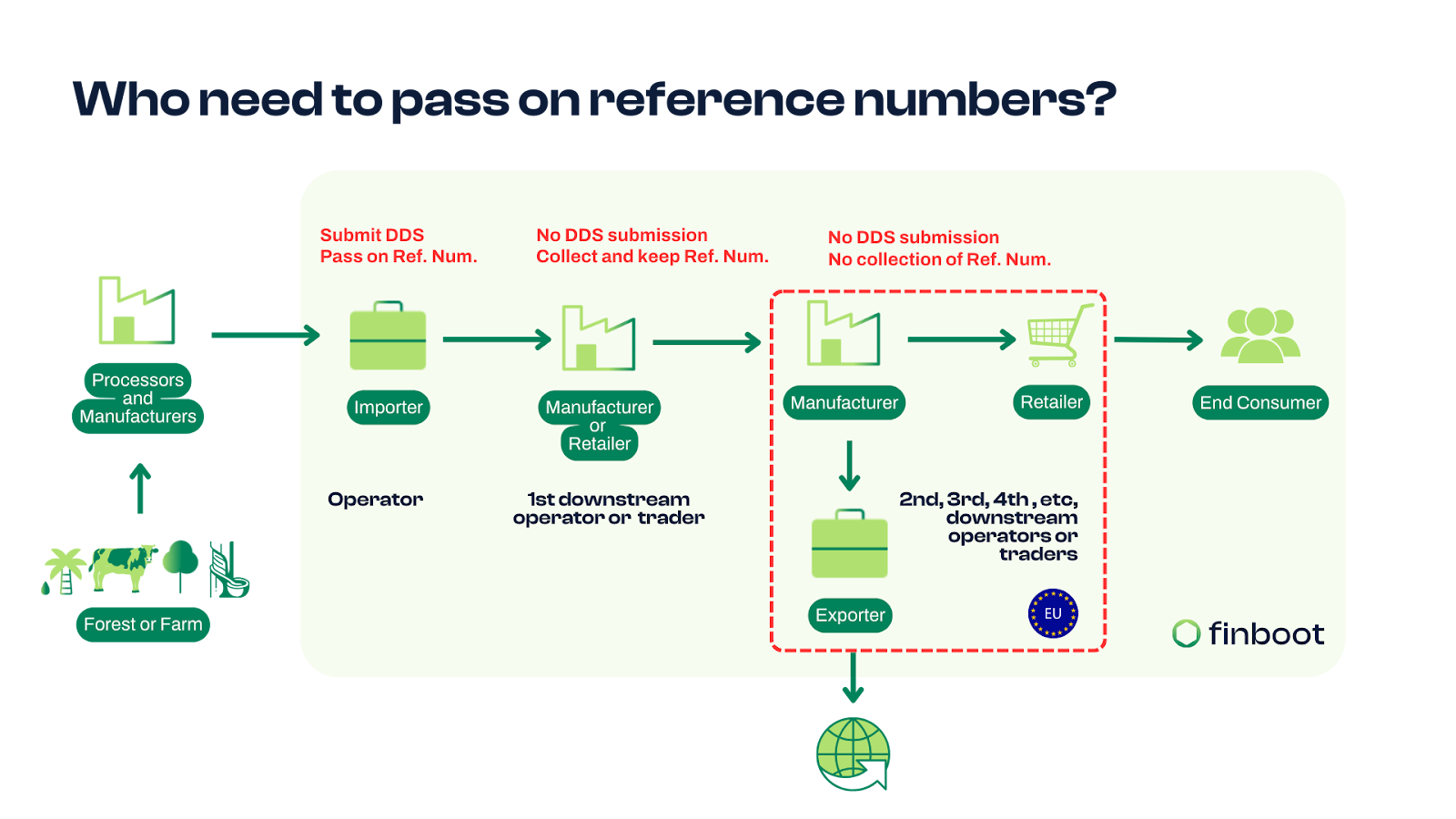
(Who needs to pass on reference numbers)
Under Article 4(7) and Article 5(3) as amended :
- Operators must communicate DDS reference numbers (or declaration identifiers for micro/small primary operators) downstream.
- The first downstream operator or trader must collect and retain those reference numbers.
- Further downstream actors are not required to collect or verify DDS references.
The amendment explicitly limits this obligation to the first downstream actor to reduce system load .
However, and this is where implementation matters, companies must still ensure that the material they process is fully covered by a valid DDS or simplified declaration.
Here’s an example:
Downstream operators are, for example, a chocolate manufacturer using cocoa covered by a due diligence declaration, or a furniture manufacturer using timber covered by a simplified declaration. Downstream operators are not required to submit due diligence declarations; only operators who place products on the Union market for the first time (primary operators) are required to submit due diligence declarations.
In practice, that requires system-level linkage between:
- Batch input
- DDS reference
- Transformation
- Output product
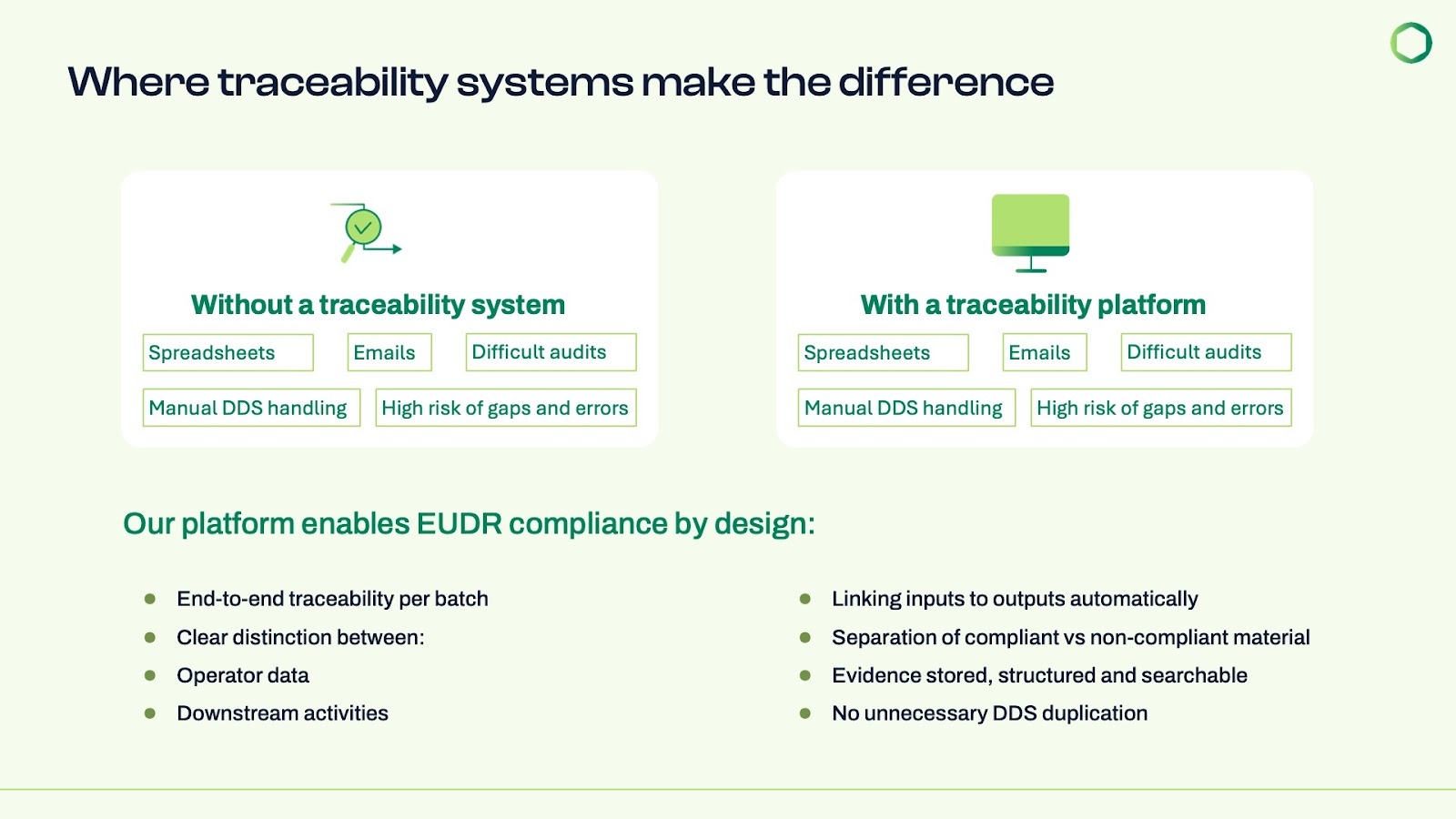
Spreadsheets cannot manage this reliably at scale.
4. The Simplified Regime for Micro or Small Primary Operators
Another significant addition is Article 4a .
Micro or small primary operators:
- Do not submit full DDS
- Submit a one-time simplified declaration
- Receive a declaration identifier
- May replace geolocation with postal address (under specific conditions)
This is a thoughtful simplification, especially for low-risk countries.
But from a systems perspective, it creates a new data flow:
Instead of referencing a DDS, downstream actors may now reference a declaration identifier.
That distinction must be structurally embedded in traceability systems.
5. Enforcement Has Become Quantified
The EUDR amended (Regulation 2025/2650) introduces clear minimum annual check percentages:
- 1% for low-risk country products
- 3% for standard-risk
- 9% for high-risk (including 9% of quantity)
This is critical.
From my experience, once companies understand that audits are percentage-driven and risk-based, compliance becomes an operational necessity, not a reputational one.
6. What This Means Operationally
After leading EUDR assessments, I consistently see five structural gaps:
- No clear role mapping across entities in the group
- No segregation logic preventing mixing of compliant and non-compliant material
- No automated linkage between DDS references and batch outputs
- No integration with TRACES / Information System
- No structured five-year record retention
The amended Regulation does not change these needs.
It only clarifies who must perform which step.
7. Why Integrated Traceability Is Not Optional
At Finboot, MARCO Track & Trace was built for regulated industrial supply chains where:
- Mass balance must be controlled
- Inputs and outputs must be linked
- Compliance must be automated
- Evidence must be structured
Our EUDR module also provides:
- API-based integration with the Information System
- Secure storage of DDS reference numbers and declaration identifiers
- Batch-level linkage
- Automated alerts when new information indicates non-compliance (as required under Article 4(5) and Article 5(5))
In our Evonik project, the challenge was not only sustainability reporting. It was data integrity across transformation steps.
Compliance becomes scalable only when it is embedded in process, not managed as documentation.
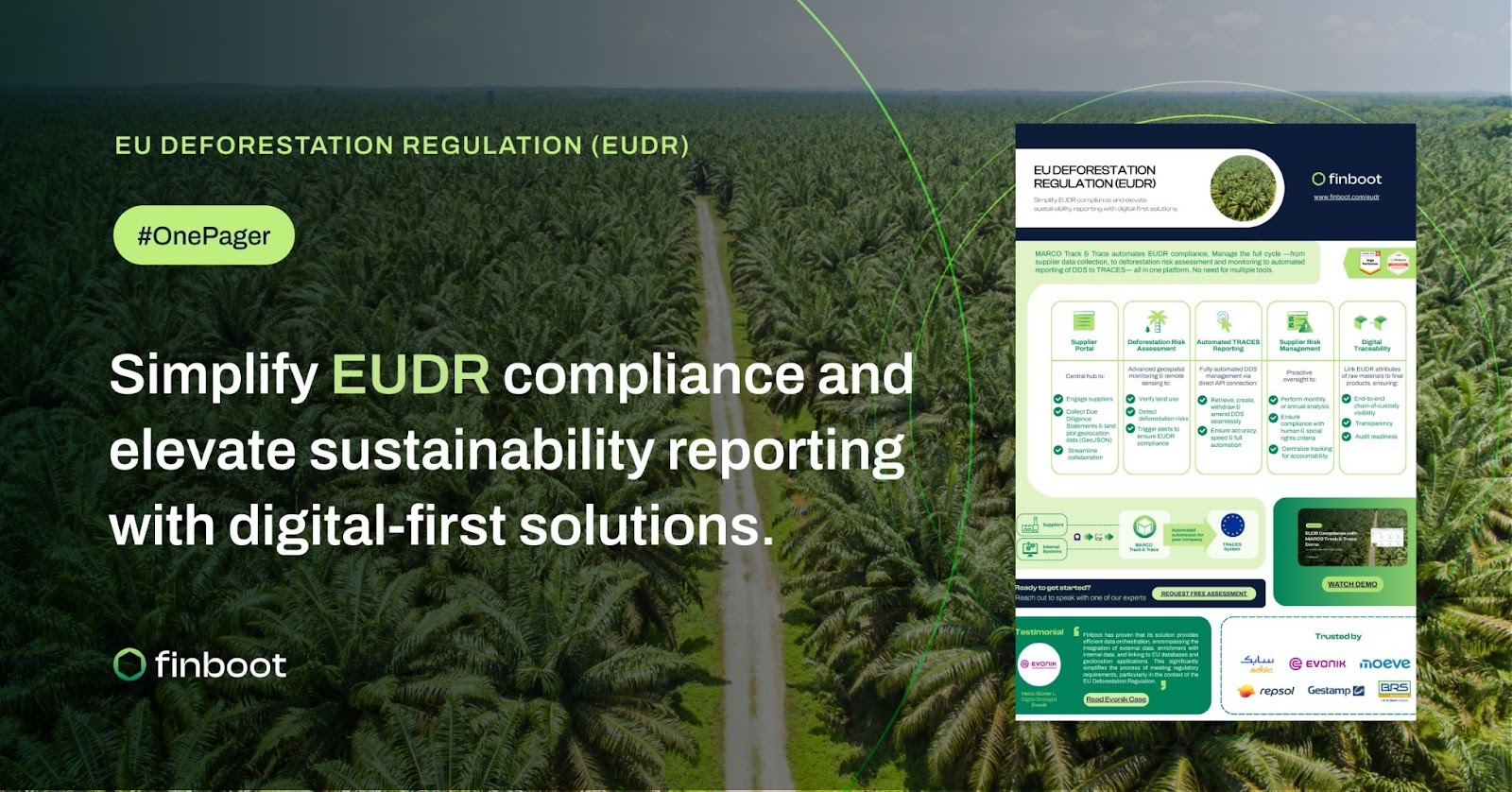
MARCO Track & Trace automates EUDR compliance, Manage the full cycle —from supplier data collection, to deforestation risk assessment and monitoring to automated reporting of DDS to TRACES— all in one platform. No need for multiple tools.
Download our EUDR One-Pager:
8. A Final Reflection
Amended EUDR was framed as a simplification.
It is, legally.
But operationally, it is a refinement.
It clarifies:
- Who does what
- When
- Through which system
- Under which audit thresholds
Companies now have clarity.
The question is whether they use this clarity to build systems, or to delay action.
Reach out if you want to learn more about Evonik use case and explore how can we help you to comply with the EUDR in time:
Frequently Asked Questions (EUDR 2026 Update)
1. When does EUDR apply after Regulation (EU) 2025/2650?
From 30 December 2026 for most operators and traders, and from 30 June 2027 for natural persons and micro/small undertakings established by 31 December 2024 .
2. What is a downstream operator under the amended EUDR?
A natural or legal person placing on the market or exporting products made using relevant products already covered by a DDS or simplified declaration .
3. Do downstream operators submit DDS?
No. The amended Regulation removes that obligation .
4. Who must collect DDS reference numbers?
Only the first downstream operator or trader .
5. What is a micro or small primary operator?
An operator producing its own relevant commodities in a low-risk country, eligible for a simplified one-time declaration .
6. Can geolocation be replaced by postal address?
Yes, for micro or small primary operators under Article 4a(5) .
7. Are audits risk-based?
Yes. Minimum annual check percentages are defined by risk category .
8. Do penalties apply to downstream operators?
Yes. Penalties apply to operators, downstream operators and traders .
9. Is TRACES integration mandatory?
Reference numbers must be made available before customs release .
10. Does EUDR still require full traceability?
Yes. Simplification does not remove traceability requirements.

.svg)
.svg)
.svg)
.png)


