

From New York to Barcelona: How Climate Weeks Became a Fixture of the Climate Calendar

Background
The climate calendar is busy this autumn. Climate Week NYC wrapped up on 27 September, Barcelona's first climate week opens on 13 October, and less than a month after that, governments gather in Antalya, Türkiye, for COP31.
Unlike climate COPs, Climate weeks are not negotiations, and nobody signs a treaty at one. What they have become is a regular meeting point: a week when companies, investors, city officials, researchers and community groups compare notes on what climate action looks like in practice.
That begs the question, does all that convening add up to climate action? Below, we trace how climate weeks spread from New York to dozens of cities globally and compare them with the UN's own Climate Weeks. Lastly, we look at what either has demonstrably achieved. We do all this in the run up to Barcelona's first edition, which opens on 13 October, an edition that is betting on a model that is about as local and decentralised as climate action gets.
What is a climate week?
At its simplest, a climate week is a city's climate events gathered into roughly seven to nine days under a single banner. Most follow an open model. An organising team sets the dates, runs a handful of flagship events and keeps a shared calendar; everyone else, from companies and universities to NGOs and neighbourhood groups, hosts their own.
London Climate Action Week describes the arrangement plainly: its secretariat provides "an open and inclusive platform, while event organisers are responsible for organising and hosting their own events". Participation is free, and organisers cover their own costs.
The result is a mixed crowd. Corporate sustainability teams, investors, start-ups, city officials, universities, NGOs and residents all turn up during the same week. The formats vary just as much: keynotes and roundtables sit alongside workshops, exhibitions, film screenings and walks. And while each week reflects its own city, many now belong to wider networks of climate weeks.
One point of confusion is worth clearing up early. The UN's climate secretariat (UNFCCC), the body behind the annual COP climate conferences, also runs events called Climate Weeks, organised with host governments. They are a different kind of event, and we compare the two models later in this article.
From one city to a global calendar
Of the cities covered here, New York had a ten-year head start. Since 2019, the format has spread much faster.
Climate Week NYC started in 2009 with a specific job to do. Climate Group, founded five years earlier, wanted to build ambition for a new global agreement at COP15 in Copenhagen, and the first edition leaned on street theatre, film premieres, music and rallies as much as on panel discussions. It is now an annual fixture and is still growing: Climate Group counted 900 events in 2024 and more than 1,000 in 2025, when it expected over 100,000 people to take part in person.
London followed a decade later. In May 2019, Mayor Sadiq Khan announced the city's first Climate Action Week, which ran from 1 to 8 July. It ended up with more than 180 events, according to E3G, the think tank that co-founded the week with the Mayor and now hosts it. 2026 marked its eighth edition.
The next shift came from San Francisco. Climatebase launched SF Climate Week in 2023, and the first edition drew more than 7,000 attendees to over 100 events, according to the City of San Francisco. Within three years, Climatebase says, it had grown to more than 25,000 participants across 650+ events, with over 3,000 organisations involved.
That growth brought a new kind of demand. Organisers around the world started asking Climatebase for its "guidance, audience, network, and tools to launch their own" climate weeks. In September 2025 it answered with the Climate Week Network, a shared platform for cities starting their own, which launched with more than 20 cities. Barcelona's first edition this October is part of it.
The format was also spreading beyond North America and Europe. Shanghai held its first climate week in April 2024, and by the following year its organisers were aiming to make it an Asian hub for climate action. In October 2025, Mexico City hosted the first Climate Action Week Mexico, which drew more than 10,000 visitors.
Here is how the format has grown, milestone by milestone. Smaller local weeks may well have existed along the way.
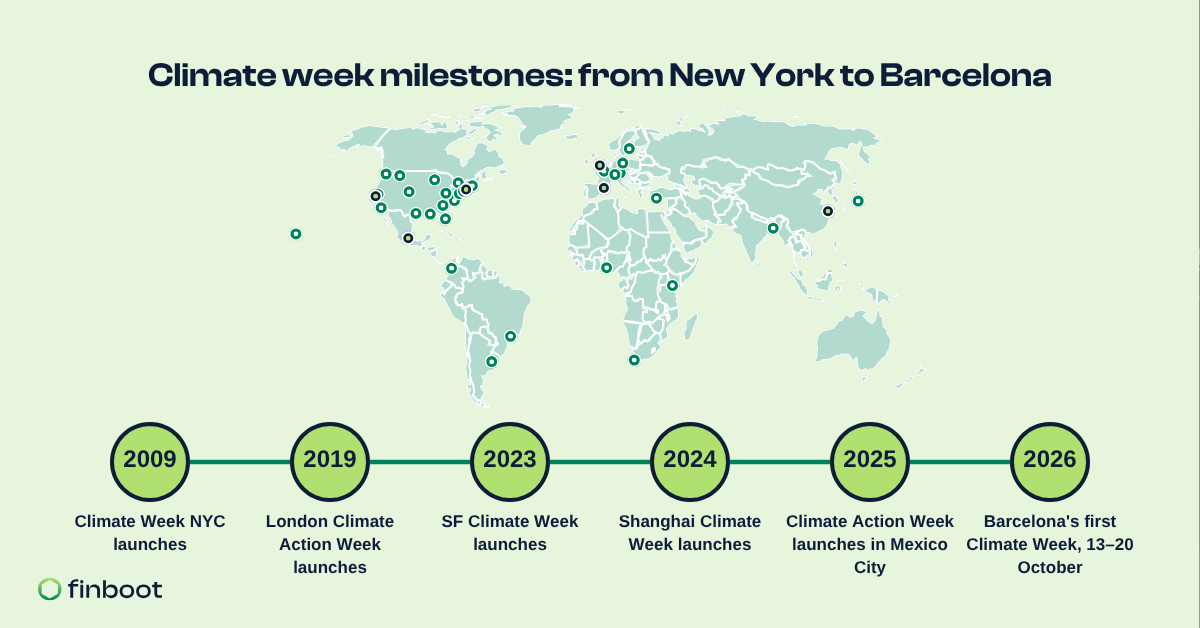
And the map keeps filling in. The Climate Week Network alone lists around 30 cities. Besides Barcelona, this autumn brings climate weeks in Missoula, Medellín, San Diego, Atlanta, Munich, Lagos and Raleigh-Durham. Dhaka, Minneapolis, Austin, Washington DC, Boston and Toronto already have 2027 dates, while Berlin, Paris, Stockholm, Tokyo, Nairobi and Cape Town are listed as coming soon. London Climate Action Week points to a network of its own, linking London with New York, Shanghai, Bangkok, Sydney and Rio de Janeiro. Some weeks sit outside both, such as Climate Week Zurich, which ran from 4 to 8 May 2026. There is no single official list of climate weeks, so any count is approximate, but the movement is clearly catching on.
City climate weeks, UN Climate Weeks and COPs: different jobs
Climate weeks often get mentioned in the same breath as COP, but they do a different job. At a COP, the UN's annual climate conference, national governments negotiate the decisions that shape the global response to climate change: the Paris Agreement is perhaps the best known example of that, adopted at COP21 in 2015. Climate weeks don't make decisions like that, and they come in two flavours.
The city weeks covered above, from New York to Barcelona, are the open, citywide kind. They work from the bottom up: anyone can host an event, and the goal is to encourage action rather than to set obligations. Alongside the annual COP, the UN also runs its own Climate Weeks, which work quite differently. They are organised by the UNFCCC secretariat with a host government and move each time: Panama City and Addis Ababa in 2025, Yeosu and Baku in 2026. Government delegations attend alongside businesses, cities, civil society and Indigenous Peoples, all at a single venue that mixes official UNFCCC meetings, policy dialogues and "Implementation Labs". The aim is to turn decisions from the UN process into action on the ground and build momentum towards the next COP.
Each has strengths the other lacks. The UN weeks sit inside the formal process, the system that sets rules, tracks national climate plans and is meant to hold governments to account. The UNFCCC says its 2023 Regional Climate Weeks contributed substantively to the Paris Agreement's first global stocktake, which concluded at COP28 in December 2023. Their reach, though, depends on governments, and governments move at the pace of consensus. City weeks have the opposite profile. They have no mandate to set rules, but they are open, fast and cheap to join: a company can launch a coalition, a city can announce a project and a start-up can meet investors without waiting for an international agreement.
In recent years, the two also lean on each other more than it might seem. City weeks borrow their timing and urgency from the UN calendar: New York runs alongside the UN General Assembly, and Barcelona closes less than three weeks before COP31. The UN's own Climate Weeks, meanwhile, increasingly bring businesses and cities into the room. So, is all this local, bottom-up action achieving what formal agreements struggle to? The next section looks at what we can, and can't, say so far.
What have climate weeks delivered?
It's hard to put a single number on what climate weeks achieve, and as far as we could find, nobody has measured their overall impact. What we can do is follow the specific initiatives launched or announced at them, and some of those have gone on to grow, or even get built.
New York offers the clearest examples. In 2014, Climate Group used Climate Week NYC to launch RE100, a corporate commitment to 100% renewable electricity. By 2024 it had more than 400 member companies, together using over 500 TWh of electricity a year. In 2017 came EV100, for corporate electric fleets; by 2022, more than 120 businesses had committed over 5.5 million vehicles to go electric by 2030.
The most tangible result is a piece of infrastructure. During Climate Week 2021, Governor Hochul announced two clean-power transmission projects. One of them, the 1,250 MW Champlain Hudson Power Express, was completed in June 2026, and the Governor's office says it can meet up to 20% of New York City's needs.
Elsewhere, the story is still being written. At London Climate Action Week 2024, C40 Cities used the week to publish green-jobs analysis and join the Mission 2025 coalition, but we haven't yet seen a published follow-up on what came of it. San Francisco hasn't published outcomes we could find, and Barcelona's first edition is still to come.
None of this takes away from the progress; it just means it's hard to say how much of it is down to the week itself. RE100 and EV100 grew through years of work by Climate Group and its members, and the Champlain Hudson line came out of a state renewable-energy tender launched months before Climate Week 2021. In each case the week gave the announcement a stage. How much it moved things along is something we can't yet prove.
Follow-through is worth watching. A 2022 study in Nature Climate Change checked 276 climate partnerships linked to UN-backed climate summits to see whether they actually did what they set out to do, such as running training, campaigns or projects. Some followed through on most of their plans; others on far fewer. And partnerships from the more recent summits did no better than older ones. The study didn't cover climate weeks, but the lesson is a useful one: a launch is a starting point, not a finish line.
Asking whether climate weeks achieve more than COPs is a bit like asking whether a trade show achieves more than a parliament. They're doing different jobs. COPs are where governments agree the rules and targets; climate weeks are where companies, cities and communities show what they're doing about them and find partners to do more. Neither works as well without the other.
So the fairest way to put it: climate weeks are good at getting commitments made in public, where others can follow them up. Whether those commitments are delivered depends on what happens in the other 51 weeks of the year.
Barcelona Climate Week: the newest test of the model
Barcelona Climate Week runs from 13 to 20 October 2026, and it is the city's first. The organisers describe it as "the inaugural Barcelona Climate Week". It is run by the Associació per la Xarxa de Ciutats per la Setmana del Clima and belongs to the Climate Week Network.
Its model is deliberately local. "There is no main stage," the organisers write; instead, the week is "decentralized by design", with talks and workshops hosted across the city by local organisations, cultural spaces, start-ups, universities and community groups, including the neighbourhood casals de barri. Attending is free, and events run in Catalan, Spanish and English.
As of 1 October, the calendar listed 43 events, with themes ranging from supply-chain decarbonisation and ESG reporting to heat-wave resilience and the climate footprint of AI. For dates, venues and registration, see the official programme.
What makes Barcelona a useful hook is less its size than its bet. Instead of chasing scale, it is trying to connect international professionals with the city's long-standing local networks: a test of whether the most decentralised version of the format can produce lasting collaboration. It also closes on 20 October, less than three weeks before COP31 opens in Antalya.
Why climate weeks still matter
Climate weeks don't set rules, and the evidence for their direct impact is limited. They still play a role that formal negotiations cannot easily fill, both for climate action and for the businesses working on it.
They are where implementation gets discussed. COPs are where governments negotiate; climate weeks are where the people expected to deliver on those agreements compare approaches. LCAW describes its network as a place where "real-world implementation happens between COPs".
They put the value chain in one place. In a single week, a sustainability or procurement lead can meet suppliers, investors, policymakers, researchers and peers. Because most programmes are open, the cost of joining in, as an attendee or as a host, is often low.

They show where the agenda is moving. Programme themes are a useful signal. In 2026, Climate Week NYC centred on electrification, EU Green Week, the European Commission's annual policy conference in Brussels, focused on a nature-positive economy, and Barcelona's calendar includes supply-chain decarbonisation, CSRD reporting and climate adaptation.
They make global issues local. A session on Barcelona's heat extremes or a regional drought cycle turns abstract climate risk into questions about specific sites, suppliers and communities.
None of this happens automatically. Open calendars mean anyone can host, so quality varies, and the headline attendance figures come from the organisers themselves. It pays to be selective: pick the sessions that relate to decisions your organisation actually faces, and go ready to ask others what they are measuring and how.
Barcelona's Test of a Growing Movement
Seventeen years after the first Climate Week NYC, climate weeks now run through much of the year: San Francisco in April, London in June, New York in September, and Barcelona, Munich and Lagos in October. Part of the appeal is simple. They are cheap to join, open to almost anyone and rooted in real places.
Barcelona's first edition will be an interesting test of where the model goes next. Rather than build a bigger stage, it is betting on neighbourhood venues and local relationships. Whether that turns into lasting collaboration is something we will only know after 20 October.
The bigger lesson is that the two kinds of climate week need each other. The UN process sets the direction and the rules; city weeks are where companies, cities and communities show, in public, what they are doing about it. Neither should be judged on attendance. Both should be judged, over time, on whether what gets announced gets built.


